ACCOUNTABILITY IN ABSENTIA: THE FAILURE OF INTERNATIONAL LAW TO DELIVER JUSTICE IN THE SYRIAN CIVIL WAR
The Syrian civil war, which began in 2011 and was formally concluded by the collapse of the Assad government in December 2024, spawned some of the most horrific atrocity crimes of the twenty-first century. More than half a million deaths occurred, and over 13 million people were displaced by force. As staggering as the scale of this horror was, international law’s mechanisms proved structurally ill provided to deliver accountability in real time. This article analyses the key legal failures enabling perpetrators to act with near-total impunity for over a decade; the paralysis of the UN Security Council, Syria’s non-ratification of the Rome Statute, the impotence of the Responsibility to Protect doctrine, and the still-narrow sweep of universal jurisdiction. It then critically assesses the creative workarounds that have been adopted, such as the International, Impartial and Independent Mechanism (IIIM), European universal jurisdiction prosecutions and civil society documentation; and reflects on what the experience of Syria teaches us about the deeper structural failings of the global legal order.
ARTICLES
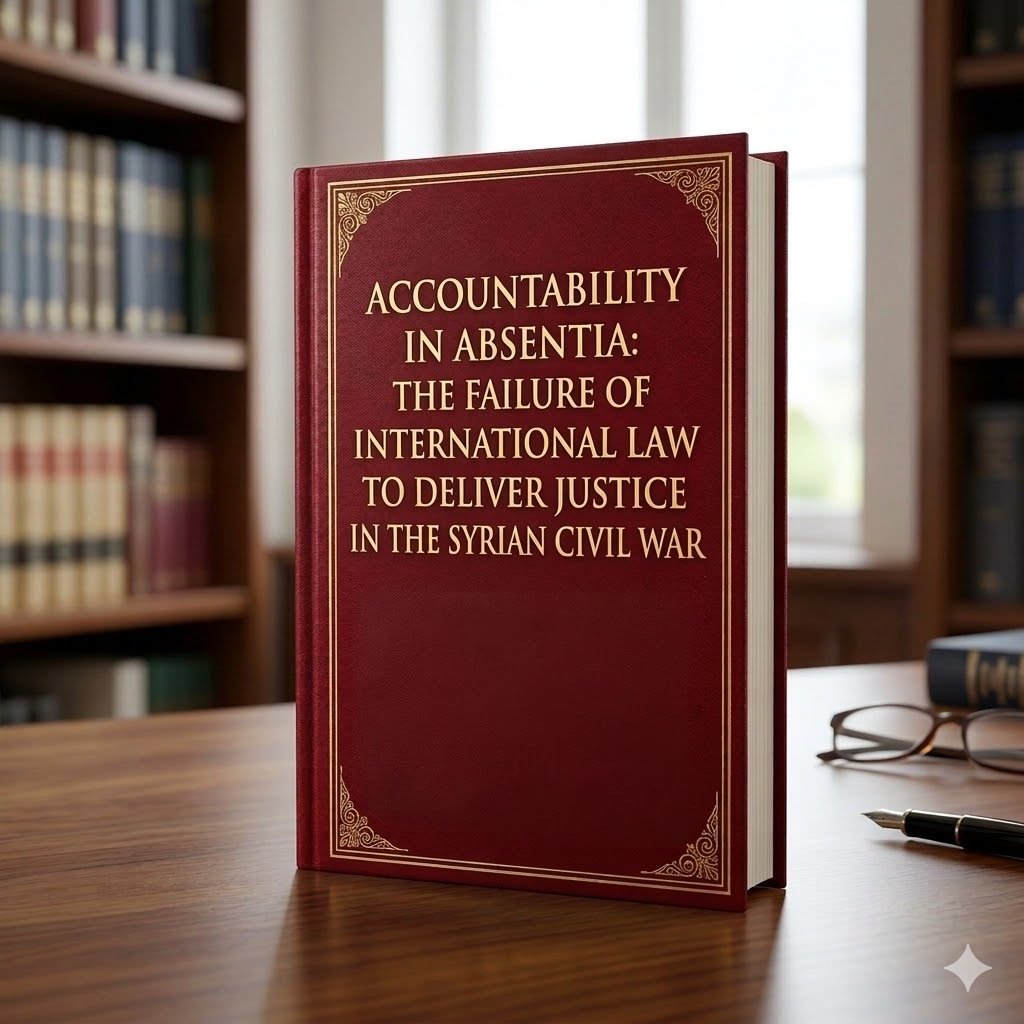
ACCOUNTABILITY IN ABSENTIA: THE FAILURE OF INTERNATIONAL LAW TO DELIVER JUSTICE IN THE SYRIAN CIVIL WAR
RICHELLE NICK. S Jain University
INTRODUCTION
When protests erupted across Syria in March 2011, few observers anticipated that what followed would become one of the deadliest conflicts of the modern era. What began as a government crackdown on peaceful demonstrations rapidly descended into a full-scale armed conflict drawing in regional and global powers, non-state armed groups, and a complex web of competing interests. By the time the Assad government fell in December 2024, the country had endured over thirteen years of systematic killing, enforced disappearances, chemical weapons attacks, siege warfare, and the wholesale destruction of civilian infrastructure.
The legal questions raised by Syria are as consequential as they are uncomfortable. Atrocity crimes were documented almost from the first days of the conflict. The United Nations Commission of Inquiry on Syria, established in August 2011, began producing evidence of war crimes and crimes against humanity with striking speed. Yet the international community's legal response was, at every turn, frustrated by geopolitics, gaps in jurisdiction, and the structural limitations of a legal architecture built for a different era. Syria became a stress test for international law. And international law, for the most part, failed. This article traces that failure analytically. It argues that the dominant frameworks of international criminal law were fundamentally unsuited to address crimes of this magnitude in a conflict shielded by great power vetoes, while acknowledging the innovative legal responses that emerged.
THE UN SECURITY COUNCIL AND THE VETO PROBLEM
The most immediate legal mechanism available to address the Syrian situation was a referral to the International Criminal Court (ICC). Syria is not a party to the Rome Statute, which means the ICC cannot exercise jurisdiction based on territorial or national grounds. The only available pathway was a Security Council referral under Article 13(b) of the Rome Statute, which allows the Council to refer situations involving non-party states. In May 2014, France circulated a draft resolution to refer the Syrian situation to the ICC. It was vetoed by Russia and China. Both nations argued that a referral would compromise prospects for a political settlement and amounted to undue interference in a sovereign state's affairs. This was not merely a political setback, it was a structural revelation. The veto power, designed to prevent great power conflict, had been converted into a shield for mass atrocity. Russia, a party actively involved in the Syrian conflict and accused of committing indiscriminate airstrikes on civilian areas, was permitted to block the very mechanism that might hold its ally accountable.
This outcome illustrated what scholars have called the 'accountability paradox' of the current UN system: the states most capable of enabling atrocity crimes are also those most capable of preventing their prosecution. The Security Council remains the sole avenue for ICC jurisdiction over non-party states, yet the architecture of the Council ensures that permanent members and their allies can insulate themselves from that jurisdiction indefinitely.
RESPONSIBILITY TO PROTECT: PROMISE AND PARALYSIS
The Responsibility to Protect (R2P) doctrine, unanimously adopted at the 2005 World Summit, was specifically designed for situations like Syria. R2P holds that when a state manifestly fails to protect its population from genocide, war crimes, ethnic cleansing, or crimes against humanity, the international community bears a collective responsibility to act, through coercive measures authorised by the Security Council. Syria presented an unambiguous case for R2P activation. The Assad government was not merely failing to protect its population; it was itself the primary perpetrator of mass atrocities. Barrel bomb attacks on civilian neighbourhoods, the use of chemical weapons; including the sarin attack in Ghouta in August 2013 that killed hundreds to over a thousand civilians, with estimates ranging from 281 to 1,429 depending on the source and the systematic torture and disappearance of tens of thousands in detention facilities all fell squarely within the paradigm that R2P was designed to address.
Yet R2P produced no meaningful intervention. The doctrine's third pillar “collective action” is contingent on Security Council authorisation. With Russia and China exercising the veto, that authorisation was never forthcoming. R2P, as the Syrian case demonstrated, is not a legal obligation but a political aspiration. It lacks enforcement mechanisms independent of the Council and therefore collapses precisely in the situations where great powers have strategic interests in non-intervention. The Syrian experience prompted serious re-evaluation of R2P's utility. A doctrine structurally dependent on the goodwill of Security Council permanent members cannot transcend the veto.
UNIVERSAL JURISDICTION: A PARTIAL BUT SIGNIFICANT RESPONSE
In the absence of ICC jurisdiction, the most significant legal accountability work was conducted under universal jurisdiction. European courts, particularly in Germany, France, Sweden, and the Netherlands, became the unlikely epicentre of Syrian war crimes accountability. The landmark case was concluded in Germany in January 2022, when a former Syrian intelligence officer, Anwar Raslan, was convicted by the Koblenz Higher Regional Court of crimes against humanity committed at a government detention facility in Damascus. It was the first conviction anywhere in the world of a senior Syrian official for crimes carried out under state authority. This was a genuinely significant development. Universal jurisdiction prosecutions demonstrated that accountability was possible even when the ICC was blocked, and that sustained civil society documentation efforts could provide the evidentiary foundation for successful prosecutions. As of 2024, according to the Universal Jurisdiction Annual Review, there were 49 active cases across nine prosecuting countries relating to international crimes committed in Syria, with 27 suspects convicted globally in first instance or on appeal in that year alone.
However, the limits of universal jurisdiction as a comprehensive accountability mechanism must be acknowledged. Proceedings are dependent on the presence of suspects in the prosecuting state's territory. Senior architects of atrocity remain largely beyond reach. Universal jurisdiction also operates at the margins of the accountability architecture; it cannot address the scale of criminality that occurred in Syria, nor can it serve the functions of truth-telling and reparations that victims most urgently need.
THE IIIM AND THE ARCHITECTURE OF EVIDENCE PRESERVATION
In December 2016, the United Nations General Assembly adopted Resolution 71/248, establishing the International, Impartial and Independent Mechanism (IIIM) to collect, preserve, and analyse evidence of serious violations of international law in Syria. The IIIM was a creative workaround for the Security Council's paralysis. The IIIM does not itself conduct prosecutions. Its mandate is to build case files that can be shared with national, regional, or international courts and tribunals. In this respect, it functions as a quasi-prosecutorial support mechanism, filling the evidentiary gap that would otherwise make accountability proceedings impractical.
The IIIM's work represents an important innovation in international accountability architecture. By decoupling evidence preservation from prosecution, it acknowledges the political realities of the current moment while keeping the possibility of future justice open. It is, in essence, a bet that accountability mechanisms will eventually become available and that when they do, the evidentiary record will be ready. Whether that bet will be vindicated remains to be seen. The fall of the Assad government in December 2024 has opened new questions about domestic accountability in Syria itself. The transitional authorities have pledged to pursue those responsible for atrocity crimes, but legal experts have expressed measured scepticism about the Syrian judicial system's capacity to conduct complex international crimes trials in accordance with fair trial guarantees.
CONCLUSION
The Syrian civil war exposed the deep structural inadequacy of the international legal order when confronted with state-sponsored atrocity shielded by geopolitical interests. The Rome Statute system could not be triggered because a Security Council permanent member exercised its veto to protect its ally. The Responsibility to Protect doctrine collapsed against the same structural obstacle. The result was over a decade of industrialised violence conducted with effective legal impunity. And yet the Syrian experience is not simply one of failure. Universal jurisdiction prosecutions in European courts, the IIIM's evidence preservation architecture, and the extraordinary documentation work of Syrian civil society represent genuine innovations in accountability practice. They could not substitute for the comprehensive ICC proceedings the situation warranted, but they kept the possibility of justice alive and produced real convictions.Syria ultimately demands structural reform, not merely better implementation of existing mechanisms. The veto's application to mass atrocity situations is an obscenity the current legal order cannot prevent. Genuine accountability requires either reform of the Security Council's veto architecture or ICC jurisdiction pathways independent of Council authorisation. Until then, the gap between international law's aspirations and its capacities will remain a space in which atrocity can flourish unchallenged.
For legal scholars, policymakers, and students of international law, Syria is not a closed chapter. It is a mirror, one that reflects, with uncomfortable clarity, the distance between the law we have and the law we need.
Resources
“Powering growth through expert-crafted knowledge—because the right resource at the right time can change everything.”
Support
Connect
support@thelegalsoul.com
thelegalsoul@gmail.com
+91 9289171838 (Whatsapp)
© 2025. All rights reserved.