ACCOUNTABILITY, PENALTIES AND THE GOA EXPERIENCE UNDER THE RTI ACT 2005
The law of the Right to Information Act, 2005 marked a turning point in the relationship between citizens and public authorities in India which gave citizens the right to get information from the public authorities keeping in view democratic participation, accountability and transparency. By recognizing access to information as a legal right, the Act strengthened democratic participation, transparency and accountability in governance. At the centre of this framework are Public Information Officers (PIOs), who are entrusted with the responsibility of receiving applications, processing requests and furnishing information to citizens within the prescribed time limits. The effectiveness of the RTI mechanism depends largely upon the conduct and efficiency of these officers. Penalties u/s 20 of the RTI Act 2005 may be imposed on the PIOs for delay, refusal, obstruction, destruction of records or supplying misleading information without reasonable cause. The onus of proving innocence is on the PIO. The provision is intended not merely as punishment but as an instrument of accountability and administrative discipline. The State of Goa has been very strict about making sure government officials are doing their job properly. If government officials are late or do not keep records they can be fined. This shows that the government is serious about being accountable to the people.
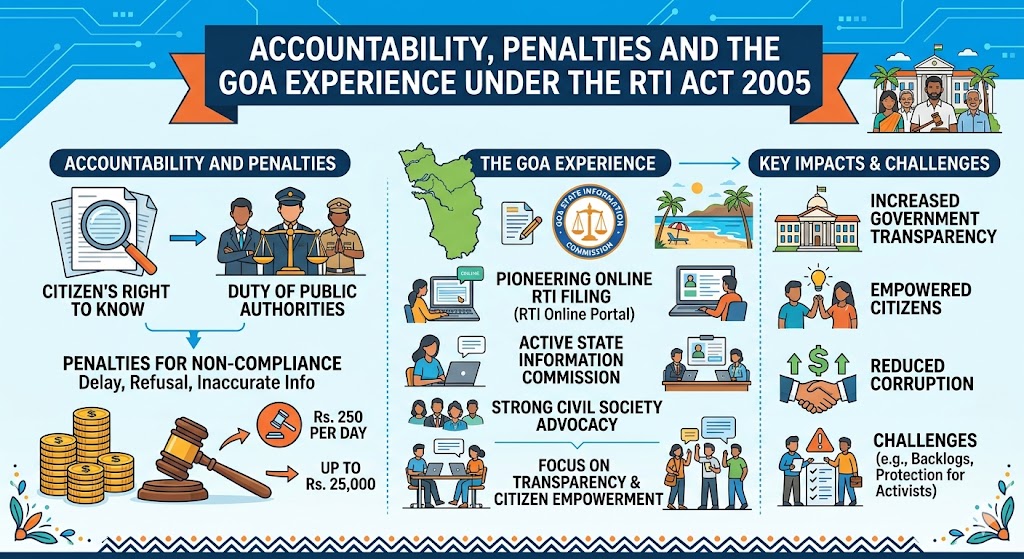
ACCOUNTABILITY, PENALTIES AND THE GOA EXPERIENCE UNDER THE RTI ACT 2005
Anthony Savio Herminio da Piedade Fernandes
INTRODUCTION
Transparency is very important for a country to be democratic. If people do not have access to information about what the government's doing then the country is not really democratic. Before the Right to Information Act was passed in 2005 it was very hard for people in India to get information, from the government. People could not get government records and know how decisions were made. The government kept things secret so people did not know what was going on. Administrative secrecy frequently prevented people from understanding how public authorities functioned and how decisions affecting their lives were made.
The Right to Information Act, 2005 transformed this situation by recognizing the citizen’s right to access information held by public authorities. The Act created a legal mechanism through which individuals could seek records, documents, reports, circulars and other forms of official information. More importantly, it imposed statutory obligations upon government departments to respond to citizens within specified timelines.
At the centre of this legal structure stands the Public Information Officer. Every public authority is required to appoint Public Information Officers to receive and process RTI applications. These officers perform a crucial administrative role because the success of the RTI system depends largely upon their efficiency, diligence and willingness to comply with the law.
However, merely creating a right to information would have been insufficient without an enforcement mechanism. If officers could ignore applications, delay responses indefinitely or deny information without consequences, the objectives of the RTI Act would be defeated. Recognizing this concern Parliament introduced Section 20. This section empowers Information Commissions to impose penalties on officers who make mistakes. They can also suggest actions in serious cases.
In years the Goa State Information Commission made some important decisions. They imposed penalties on Public Information Officers or PIOs for delays. The Commission also penalized PIOs for being careless and not maintaining records properly. These developments show that there is a growing focus on accountability and being responsible in Goa.
This article analyses the legal framework of Section 20, the nature of RTI penalties and the practical developments emerging from Goa. It further examines whether the penalty mechanism is functioning effectively in promoting transparency and responsible governance.
OBJECTIVES OF THE STUDY
The objectives of this article are:
To understand the framework governing penalties under Section 20 of the RTI Act 2005.
To study and analyse the circumstances under which penalties may be imposed upon Public Information Officers.
To examine recent developments and reported RTI penalty cases, particularly from Goa.
To understand the effectiveness of the penalty mechanism in ensuring transparency and compliance in the State of Goa.
RESEARCH METHODOLOGY
This study adopts a doctrinal and analytical approach. The article relies upon statutory provisions, reported decisions, official material and newspaper reports concerning RTI penalties and proceedings. Particular emphasis has been placed on developments arising from the Goa State Information Commission and reported cases involving Public Information Officers in Goa.
The study does not involve empirical surveys or interviews. Instead, it focuses upon interpretation of Section 20 of the RTI Act and its practical application in administrative settings as per various news reports.
THE LEGAL FRAMEWORK UNDER SECTION 20 OF THE RTI ACT
Section 20 of the RTI Act contains the principal penalty provisions applicable to Public Information Officers. It represents the enforcement backbone of the RTI regime.
Under Section 20(1), the Information Commission may impose a penalty of ₹250 per day upon the PIO for delay or wrongful conduct, subject to a maximum penalty of ₹25,000. The provision applies where the officer refuses to receive an RTI application, fails to furnish information within the prescribed period, malafidely denies information, knowingly gives incorrect, incomplete or misleading information, destroys information sought under the Act; or obstructs furnishing of information in any manner.
The provision also says that before any penalty is imposed the officer must have a opportunity to speak up and clarify his stand and prove innocence. This safeguard helps make sure that the rules of fairness are followed. Section 20(2) gives the Information Commission the power to suggest taking action, against the officer in charge under the service rules that apply. This happens when it is clear that the officer was very careless or did something wrong and this keeps happening.
The RTI framework has a three-tier structure consisting of:
The Public Information Officer;
The First Appellate Authority; and
The Information Commission.
This structure is intended to provide citizens with both access and remedies in cases of non-compliance.
NATURE AND PURPOSE OF RTI PENALTIES
Penalties under the RTI Act are accountability and enforcement of statutory duty and purely in administrative rather than criminal in nature. The RTI system would lose effectiveness if officers could delay or deny information without consequences. Citizens often seek information relating to land disputes, welfare schemes, public expenditure, environmental matters and administrative decisions. Delayed information frequently becomes meaningless because administrative actions may already have been completed by the time records are supplied. The penalty mechanism therefore serves several important purposes.
DETERRENCE AGAINST NEGLIGENCE AND OBSTRUCTION
The existence of financial penalties discourages deliberate delay and negligence. Officers are expected to treat RTI applications as statutory obligations rather than optional administrative tasks.
ENCOURAGEMENT OF PROPER RECORD MANAGEMENT
RTI compliance requires proper maintenance of records. Public authorities cannot supply information unless documents are properly preserved and indexed. Penalties encourage departments to improve record systems and administrative efficiency.
PERSONAL ACCOUNTABILITY
An important feature of Section 20 is that penalties are imposed personally upon the concerned officer rather than upon the department as a whole. This individual accountability distinguishes the RTI mechanism from many other administrative laws.
STRONG PUBLIC CONFIDENCE
When Information Commissions impose penalties in appropriate cases, it reinforces strong public confidence in the transparency framework and citizens are more likely to use the RTI mechanism if they believe that violations will attract consequences.
THE IMPORTANCE OF “REASONABLE CAUSE”
Section 20 does not mandate punishment in every case of delay or denial. The phrase “without reasonable cause” plays a central role in determining liability. The Information Commission must examine whether the officer had a genuine explanation for the delay or non-compliance. For example, circumstances such as transfer of records, natural disasters or lack of control over the relevant files may sometimes constitute reasonable cause.
The burden of proving reasonable conduct lies upon the PIO. This is significant because the PIO is expected to demonstrate diligence and good faith in handling RTI applications. Various State Information Commissions and Cental Information Commissions and courts have repeatedly emphasized that casual explanations cannot excuse non-compliance. Statements such as “the file was not traceable” or “records were missing” are increasingly viewed as indicators of administrative failure rather than valid defences. This principle has become particularly visible in Goa, where several cases have involved missing records, incomplete replies and repeated non-compliance by local authorities.
THE GOA EXPERIENCE: INCREASING ENFORCEMENT BY THE STATE INFORMATION COMMISSION
Recent developments in Goa show that authorities are getting tougher on enforcing the Right to Information or RTI. The Goa State Information Commission is now more strict, about punishing people who do not follow RTI rules. They are imposing penalties on cases where information officers are careless and delay in providing information or do not keep proper records.
In February 2026 the Goa State Information Commission punished the Secretary and Public Information Officer of the Majorda-Utorda-Calata Panchayat. They had to pay a penalty of ₹50,000 for not giving information and not following RTI directions. The Commission said the money should be taken from the officers salary. They also stressed the need to keep records properly. The Goa State Information Commission wants to make sure that RTI rules are followed. Officers must provide information on time. Keep proper records.
Similarly, the Commission imposed a penalty of ₹25,000 upon the PIO of Village Panchayat Latambarcem for RTI violations. The decision reflected the Commission’s view that repeated disregard of statutory obligations cannot be tolerated.
Another important matter involved officials of the Goa Industrial Development Corporation (GIDC). In this case, information was denied on the ground that the relevant file was “missing.” The Commission imposed penalties. Told them what to do to fix the records and look into what happened to the missing files. The Commission is the one that imposed these penalties. They are the ones that directed steps for reconstruction of records and investigation into the disappearance of files.
The Goa State Information Commission is also the one that has taken action against the authorities for being careless and taking long to do things. The Commission criticized the officers for being very careless when they were giving out information. The Commission observed that when the officers mishandle the RTI applications in a way it makes the public lose trust in the way the government is runned.
DELAY AS A FORM OF DENIAL
One of the common RTI violations is delay in giving information. The RTI Act says that information should be given within thirty days of getting the application. If this does not happen it is deemed denial of the information. In January 2025 the Goa State Information Commission fined a Panchayat Secretary ₹22,500 for delaying information about a building issue in Utorda. The Commission said that long delays make the RTI Act useless. This is important because information is often needed quickly. If information is given late citizens may not be able to challenge decisions, join discussions or protect their rights. RTI information is key here. Delay in RTI information hurts citizens. The RTI Act needs to be followed to give citizens their rights. Delayed RTI information causes problems, for citizens.
The Commission further observed that legal expenses incurred by the officer in defending RTI proceedings should not be paid from public funds and must be borne personally. This observation reinforces the idea that RTI penalties are personal consequences arising from failure to discharge statutory duties.
MISSING FILES AND ADMINISTRATIVE FAILURE
A recurring issue in RTI cases is the claim that files are “missing” or “not traceable.” Public authorities often rely upon this explanation when unable to supply information. However, Information Commissions have increasingly held that disappearance of files cannot automatically excuse non-compliance. When we do not take care of records it is hard to be transparent. This creates chances for people to be corrupt and cheat. The GIDC matter in Goa is very important here. The Commission did two things. They fined people. They also told the authorities to fix the missing records and find out how the files got lost. This shows that losing records is a problem for the administration. We see the thing when local bodies and panchayats, in Goa have meetings. They often find that they are not doing a job of keeping track of records saving them and getting them when they need them. All these things show that transparency and record management are closely connected to each other. Transparency and record management are very important. The RTI framework cannot function effectively unless government departments maintain reliable documentation systems.
ACCOUNTABILITY OF LOCAL AUTHORITIES AND PANCHAYATS
Several RTI disputes in Goa have arisen from panchayats and local authorities. These institutions are really important for things like controlling land use, giving construction permits, collecting taxes and running governments. People often use the Right To Information to get details about building approvals, public projects and decisions made by administrators. The fact that penalties are being imposed again and again on panchayat officers shows that local governments are being watched closely. Look at what happened with the Colva Panchayat, the Sancoale Panchayat and the Majorda-Utorda-Calata Panchayat. These cases show that the Goa State Information Commission is getting serious about holding officers responsible when they do not follow the rules. This is all important because local authorities have an impact on our daily lives. So it is crucial that we have transparency at this local level, which means we need to know what is going on at the local levels. This helps people participate in democracy, and stops administrators from making unfair decisions.
JUDICIAL APPROACH TOWARDS RTI PENALTIES
Indian courts have generally supported the principle that Public Information Officers bear statutory responsibilities under the RTI Act. Courts have repeatedly observed that the Act is intended to promote openness and prevent administrative secrecy. At the same time, courts have clarified that penalties should not be imposed mechanically. Information Commissions must consider whether there was deliberate obstruction or whether the officer acted with reasonable diligence. The judicial approach therefore seeks to balance accountability with fairness. While negligent or obstructive officers may be penalized, honest mistakes or unavoidable administrative difficulties may sometimes justify leniency. This balanced interpretation is important because excessive penalization without considering circumstances may discourage officers from accepting RTI responsibilities or lead to overly defensive administrative behaviour.
PUBLIC PERCEPTION AND PRACTICAL CONCERNS
Despite the existence of Section 20, many RTI users believe that penalties are imposed inconsistently across India. Citizens often complain that Information Commissions issue warnings rather than financial penalties even in cases involving substantial delay. Delayed hearings and backlog of appeals further reduce the effectiveness of the RTI system. Public discussions and newspaper reports frequently reflect frustration regarding slow disposal of appeals, weak enforcement of Commission orders, repeated adjournments, failure to recover imposed penalties; and continued bureaucratic resistance to transparency.
At the same time, recent decisions from Goa suggest that Information Commissions are becoming stricter, particularly where officers ignore notices or repeatedly fail to cooperate with proceedings. Some commentators have even argued that the existing maximum penalty of ₹25,000 is insufficient in modern administrative conditions and should be enhanced to ensure greater deterrence. Public discussions in Goa have reflected this demand for stronger enforcement mechanisms.
CONCLUSION
Section 20 of the Right to Information Act, 2005 remains one of the most important enforcement provisions in Indian transparency law. The provision recognizes that the right to information can become meaningless unless public authorities are held accountable for non-compliance. The recent decisions of the Goa State Information Commission demonstrate an increasingly proactive approach towards enforcement. Penalties imposed upon Public Information Officers for delay, denial of information, negligence and poor record management indicate a growing commitment to administrative accountability. These decisions are important because they reinforce a fundamental democratic principle: public information belongs to citizens and not to government offices.
At the same time, the RTI framework must remain fair and balanced. Public Information Officers require adequate training, institutional support and efficient record systems to perform their duties effectively. Transparency cannot be achieved merely through punishment; it also requires administrative reform and modernization.
The Goa experience highlights both the strengths and weaknesses of the RTI system. While the Commission has shown willingness to impose penalties in appropriate cases, recurring disputes involving missing files and delayed responses reveal deeper institutional challenges. Ultimately, the effectiveness of the RTI Act depends upon a culture of openness within public administration. Section 20 serves as a reminder that democracy requires transparency, responsibility and respect for the citizen’s right to know.
REFERENCES
Daijiworld. (2026). Goa Information Commission fines PIO Rs 25,000 for RTI violations. Daijiworld
Herald Goa. (2022). CCP PIO served show-cause notice for delaying information. Herald Goa
Herald Goa. (2025). RTI Commission pulls up PIO, orders probe into missing p’yat circular. Herald Goa
Prudent Media. (2025). PIO of Mapusa Municipal Council is not competent: GSIC. Prudent Media
The Goan. (2019). Public Information Officer directed to repay excess amount charged to RTI applicant. The Goan
The Goan. (2025). Commission raps PIO for gross negligence in giving RTI info. The Goan
The Goan. (2025). Denial of RTI: SIC pulls up Social Welfare Dept, orders action against PIO & appellate authority. The Goan
The Goan. (2026). Enhance RTI fine amount to improve efficiency of PIOs. The Goan
The Goan. (2024). RTI fine for PIOs must be hiked to Rs 1000 per day. The Goan
Times of India. (2016). GSIC slaps Rs 25,000 fine on Sancoale PIO. Times of India
Times of India. (2020). PIO of Colva Panchayat fined under RTI Act. Times of Indi
Times of India. (2023). SIC penalises two officials for not providing due info. Times of India
Times of India. (2023). Sancoale public info officer fined for dodging RTI query. Times of India
Times of India. (2025). RTI penalty: P’yat secy fined Rs 22.5k. Times of India
Times of India. (2026). GIDC officials fined after RTI info denied due to missing file. Times of India
Times of India. (2026). Majorda p’yat secy to pay 50k for denying info under RTI Act. Times of India
Right to Information Act, 2005. (2005). Government of India.
Resources
“Powering growth through expert-crafted knowledge—because the right resource at the right time can change everything.”
Support
Connect
support@thelegalsoul.com
thelegalsoul@gmail.com
+91 9289171838 (Whatsapp)
© 2025. All rights reserved.