DIGITAL DIVIDE AS CONSTITUTIONAL EXCLUSION: RETHINKING ACCESS TO JUSTICE UNDER ARTICLES 14 AND 21 IN THE ERA OF E-COURTS AND VIRTUAL HEARINGS IN INDIA
The Indian judiciary has undergone a profound digital transformation, accelerated by the COVID-19 pandemic and institutionalised through the e-Courts project, now in its ambitious Phase III. With substantial investments—over ₹7,210 crore allocated for digitising records, expanding virtual courts, deploying AI tools, and establishing nearly 2,000 e-Sewa Kendras—the system promises greater efficiency, transparency, and reduced physical barriers. Virtual hearings, e-filing, and online case management have become routine, with millions of proceedings conducted remotely and vast troves of court records (hundreds of crores of pages) digitised by early 2026. Yet, this shift raises a fundamental question: does technological advancement truly democratise justice, or does it create new forms of exclusion that undermine constitutional guarantees. This article argues that the persistent digital divide—marked by uneven internet access, low digital literacy (especially in rural areas where only about 31% use the internet compared to 67% urban), device affordability gaps, and infrastructural deficits—functions as a form of constitutional exclusion. It disproportionately affects marginalised groups: rural litigants, women, persons with disabilities, elderly individuals, and economically weaker sections. Such barriers violate the equality mandate under Article 14 by creating indirect discrimination between similarly situated citizens and infringe the right to life and personal liberty with dignity under Article 21, which encompasses access to justice as an essential facet of fair procedure and open courts.Drawing from Supreme Court observations during the pandemic (guidelines on video conferencing in 2020) and recent rulings like Pragya Prasun & Ors. v. Union of India and Amar Jain v. Union of India (2025), which recognised digital accessibility as integral to Article 21 for persons with disabilities, the paper critically examines how e-Courts Phase III, while laudable in intent, risks deepening inequalities without deliberate inclusivity measures. Comparative insights from jurisdictions that have grappled with similar challenges highlight the need for hybrid models that do not abandon physical access. Through doctrinal analysis and socio-legal reflection, this piece contends that access to justice in the digital age must be reimagined not merely as technological efficiency but as substantive constitutional equality. It proposes reforms including mandatory accessibility standards, expanded and effective e-SewaKendras, digital literacy integration in legal aid, and judicial oversight to ensure that virtual systems supplement rather than supplant traditional mechanisms. Only then can the judiciary fulfil its role as the guardian of constitutional values in a diverse democracy.
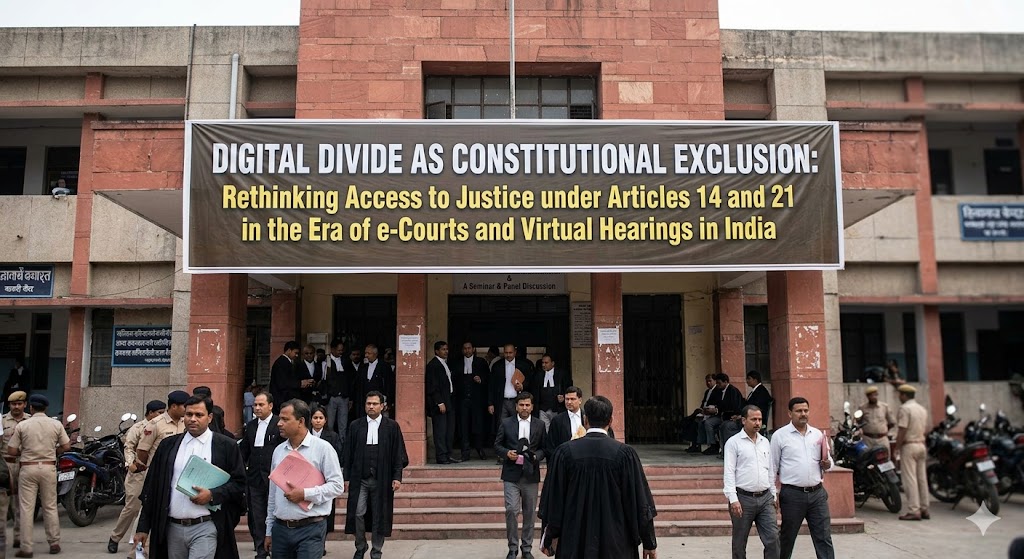
Digital Divide as Constitutional Exclusion: Rethinking Access to Justice under Articles 14 and 21 in the Era of e-Courts and Virtual Hearings in India
Shatakshee Rawat, Shibli National College
Keywords: Digital Divide, Access to Justice, e-Courts Phase III, Articles 14 and 21, Virtual Hearings, Constitutional Exclusion, Digital Accessibility
Introduction
The Indian judicial system has historically faced structural challenges, including a substantial case backlog and an inadequate judge-to-population ratio.¹ In response, the judiciary has increasingly turned to technological solutions to enhance efficiency and accessibility. The e-Courts project, particularly Phase III, represents a comprehensive effort to digitise judicial processes through e-filing, virtual hearings, artificial intelligence tools, and the establishment of e-Sewa Kendras.²
Access to justice has long been recognised as a foundational principle of constitutional democracies and an essential component of the rule of law.³ The global “access to justice” movement emphasises the need to make legal rights practically enforceable rather than merely theoretical.⁴
The COVID-19 pandemic significantly accelerated this transition. In April 2020, the Supreme Court issued guidelines for court functioning through video conferencing, ensuring continuity of judicial proceedings during the public health crisis.⁵ Over time, virtual hearings and hybrid systems have become institutionalised features of justice delivery.
However, this transformation raises critical constitutional concerns. The reliance on digital infrastructure introduces new barriers for individuals lacking access to technology, thereby risking exclusion from judicial processes. In a socio-economically diverse country like India, disparities in internet access, digital literacy, and affordability can undermine the principles of equality and fair procedure.⁶
2. Theoretical and Constitutional Foundations
Access to justice is not an abstract ideal but a core constitutional entitlement. The Supreme Court has repeatedly held it as part of the right to life and liberty under Article 21, encompassing speedy trial, fair hearing, and the open court principle⁷. In Swapnil Tripathi v. Supreme Court of India, live-streaming was recognised as advancing transparency and public access.⁸ Article 14 demands equality before the law and equal protection, prohibiting both direct and indirect discrimination.The digital divide complicates this framework. It manifests in three interconnected layers: infrastructure (broadband availability), affordability (devices and data costs), and capability (digital literacy and language barriers). In a country where rural internet usage lags significantly behind urban, and where a substantial portion of the population remains digitally illiterate, mandating e-filing or virtual appearances can exclude citizens who are otherwise entitled to equal justiceFrom a critical perspective, technology does not operate neutrally. Algorithms and platforms embed assumptions about users—assumptions that often privilege urban, educated, able-bodied, English-literate individuals. When courts shift online without addressing these biases, they risk transforming procedural justice into a privilege rather than a right. This echoes broader concerns in feminist and disability jurisprudence: formal equality (providing the same digital tools) fails when substantive barriers persist.¹⁰
3. The Digital Transformation of Indian Judiciary: Progress and Promises
The e-Courts project has achieved notable milestones. Phase III, backed by substantial central funding, envisions citizen-centric digital courts. Key features include mandatory e-filing in many jurisdictions, expansion of virtual courts (with plans for 1,150 across the country), AI tools for translation (SUVAS) and case analysis, and cloud-based repositories. By mid-2025, video conferencing facilities existed in thousands of courts and jails, millions of online hearings had occurred, and e-Sewa Kendras were operational to assist those without personal access.¹¹
Proponents rightly celebrate reduced pendency in certain categories (like traffic challans via virtual courts), cost savings, environmental benefits, and greater transparency through portals and mobile apps. The vision document for Phase III emphasises “justice as a service,” guided by principles of access and inclusion inspired by Gandhian thought.¹²
However, progress remains uneven. While 99.5% of court complexes may be connected to networks, the quality and reliability vary dramatically. Rural districts often face power outages, poor connectivity, and limited technical support. The judge shortage—exacerbated by high vacancies in subordinate courts—means that even digitised systems struggle with backlog, shifting rather than resolving systemic pressures.¹³
4. Digital Divide as Constitutional Exclusion: Doctrinal Analysis
The core argument here is that digital barriers amount to unconstitutional exclusion. Under Article 14, when two litigants with identical claims face different procedural hurdles—one navigating e-filing seamlessly from an urban home, the other travelling hours to a distant e-Sewa Kendra or missing hearings due to network failure—the equality guarantee is breached through indirect discrimination.¹⁴
Article 21 is even more directly implicated. Access to justice includes the right to be heard effectively, present evidence, and engage with proceedings. In Pragya Prasun and Amar Jain (2025), the Supreme Court explicitly linked digital accessibility to Article 21, directing reforms for e-KYC processes to accommodate disabilities.¹⁵ The Court recognised that exclusion from digital platforms for essential services violates dignity and liberty. This logic extends powerfully to judicial processes: if inability to complete digital KYC denies banking access, inability to participate in virtual hearings denies justice itself.
The pandemic guidelines acknowledged virtual hearings as temporary, yet their normalisation without safeguards raises concerns about open justice. Not every litigant can afford or access the technology required for meaningful participation. For women in conservative households, rural elders, or persons with disabilities, virtual formats may heighten vulnerabilities—technical glitches during testimony, privacy risks, or inability to consult lawyers effectively.¹⁶ Recent data underscores the scale: significant rural-urban disparities in internet access persist, digital literacy remains low in many regions, and e-Sewa Kendras, while helpful, are insufficient in number and reach for a population of 1.4 billion.¹⁷ When courts prioritise digitisation without parallel investment in hybrid accessibility, they inadvertently create a two-tier justice system.
5. Comparative Insights
Other jurisdictions offer valuable lessons. The EU’s e-Justice portal emphasises accessibility standards and multi-channel approaches.¹⁸ The UK’s online courts incorporate user testing for vulnerable groups and maintain physical fallbacks.¹⁹ In the US, federal initiatives address broadband gaps alongside court technology.²⁰ These models suggest that successful digital justice requires not just infrastructure but proactive measures: universal design principles, legal aid integration for digital navigation, and regular judicial audits of exclusionary impacts.India can adapt these by mandating accessibility audits for all e-Courts platforms, expanding effective e-Sewa Kendras with trained staff, and integrating digital literacy into legal services authority programmes. A “Digital Justice Charter” could statutorily enshrine the right to choose between physical and virtual modes where technology poses barriers.
6. Towards Transformative Reforms
Meaningful reform demands moving beyond incremental fixes. First, enact guidelines ensuring hybrid options remain robust, with physical hearings available as of right for those demonstrating need.²¹ Second, invest in last-mile connectivity and subsidised devices/data for marginalised litigants through legal aid. Third, incorporate universal design in all platforms—voice interfaces, regional languages,screen-reader compatibility—building on the Pragya Prasun precedent.²² Fourth, mandate training for judges and court staff on digital divide issues, and collect disaggregated data on exclusion incidents. Finally, the Supreme Court and High Courts should exercise continuing oversight, perhaps through periodic reports on inclusivity metrics.These steps would align technological ambition with constitutional morality, ensuring that e-Courts serve as an enabler rather than a gatekeeper.
7. Conclusion
The digital turn in Indian justice delivery holds immense promise for overcoming traditional barriers of distance and delay. Yet, as Phase III unfolds, we must confront an uncomfortable truth: without addressing the digital divide head-on, we risk replacing one form of exclusion with another. The constitutional vision under Articles 14 and 21 demands substantive, not formal, access—justice that reaches every citizen in their lived reality.As scholars, we have a responsibility to highlight these tensions and advocate for reforms that centre the most vulnerable. A truly inclusive judiciary will not measure success solely by the number of virtual hearings or digitised pages, but by whether the marginalised can meaningfully participate. Bridging the digital divide is not a technical add-on; it is a constitutional imperative. Only then can we claim that justice in the digital age remains justice for all.
References
Law Commission of India, Report No. 245: Arrears and Backlog: Creating Additional Judicial (wo)manpower (2014).
e-Committee, Supreme Court of India, Vision Document for Phase III of the e-Courts Project.
Anita Kushwaha v. Pushap Sudan, (2016) 8 SCC 509.
Mauro Cappelletti & Bryant Garth, “Access to Justice: The Newest Wave in the Worldwide Movement to Make Rights Effective” 27 Buffalo Law Review 181 (1978).
In Re: Guidelines for Court Functioning Through Video Conferencing During COVID-19 Pandemic, Suo Motu Writ (Civil) No. 5 of 2020, order dated 6 April 2020.
Telecom Regulatory Authority of India (TRAI), internet and broadband penetration statistics; Ministry of Statistics and Programme Implementation, relevant digital access data.
Hussainara Khatoon v. Home Secretary, State of Bihar, (1980) 1 SCC 81; Anita Kushwaha v. Pushap Sudan, (2016) 8 SCC 509.
Swapnil Tripathi v. Supreme Court of India, (2018) 10 SCC 639.
Ministry of Statistics and Programme Implementation / NSSO / relevant national digital access datasets.
Martha Albertson Fineman, The Illusion of Equality (1991); UN Committee on the Rights of Persons with Disabilities, General Comment on Accessibility.
e-Committee, Supreme Court of India, implementation and progress reports on e-Courts; Ministry of Law and Justice, Government of India, data on virtual courts and e-Sewa Kendras.
e-Committee, Supreme Court of India, Vision Document for Phase III of the e-Courts Project.
Law Commission of India, Report No. 245; Department of Justice, court vacancy and infrastructure data.
State of Kerala v. N.M. Thomas, (1976) 2 SCC 310; Navtej Singh Johar v. Union of India, (2018) 10 SCC 1.
Pragya Prasun & Ors. v. Union of India and Amar Jain v. Union of India, 2025 INSC 599.
In Re: Guidelines for Court Functioning Through Video Conferencing During COVID-19 Pandemic, Suo Motu Writ (Civil) No. 5 of 2020.
Ministry of Electronics and Information Technology, Government of India; national digital inclusion data; e-Committee implementation records.
European e-Justice Portal, accessibility and digital justice resources.
UK Ministry of Justice Portal/HM Courts & Tribunals Service, online court reform and accessibility resources
National Center for State Courts / Administrative Office of the U.S. Courts, remote proceedings and access-to-justice studies.
In Re: Guidelines for Court Functioning Through Video Conferencing During COVID-19 Pandemic, Suo Motu Writ (Civil) No. 5 of 2020.
Pragya Prasun & Ors. v. Union of India and Amar Jain v. Union of India, 2025 INSC 599.
Anita Kushwaha v. Pushap Sudan, (2016) 8 SCC 509; Swapnil Tripathi v. Supreme Court of India, (2018) 10 SCC 639.
Resources
“Powering growth through expert-crafted knowledge—because the right resource at the right time can change everything.”
Support
Connect
support@thelegalsoul.com
thelegalsoul@gmail.com
+91 9289171838 (Whatsapp)
© 2025. All rights reserved.