DIGITAL DOCTOR MULTIMODALITY AI-ASSISTED FRAMEWORK. TRIAGE PATIENT PROFILING AND TELECONSULTATION IN RESOURCE-MINIMAL MEDICAL CARE FACILITIES.
Limited resources in healthcare settings can result in disjointed patient data, clinician shortages, and inefficient first-contact workflows. In this paper, it is proposed to introduce Digital Doctor, the framework that incorporates multimodal artificial intelligence that assists patients with onboarding, symptom tracking, vital-sign monitoring, report digitalisation, patient profiling, and human-supervision teleconsultation. The system design comprises of data acquisition and sensing layer, edge level verification that verifies that the data is correct, secure longitudinal data storage, and a review interface by clinicians.. This setup enables rapid patient-data collection, validity verification, and transmission of a summarised case form to healthcare providers. The framework follows a conservative design stance that includes multilingual support, offline operation, privacy-sensitive storage options, modular technology, and decision-making processes that preserve clinician control. A plan to evaluate measurement accuracy, referral sensitivity, processing latency, usability, and patient satisfaction is also proposed.
RESEARCH PAPER
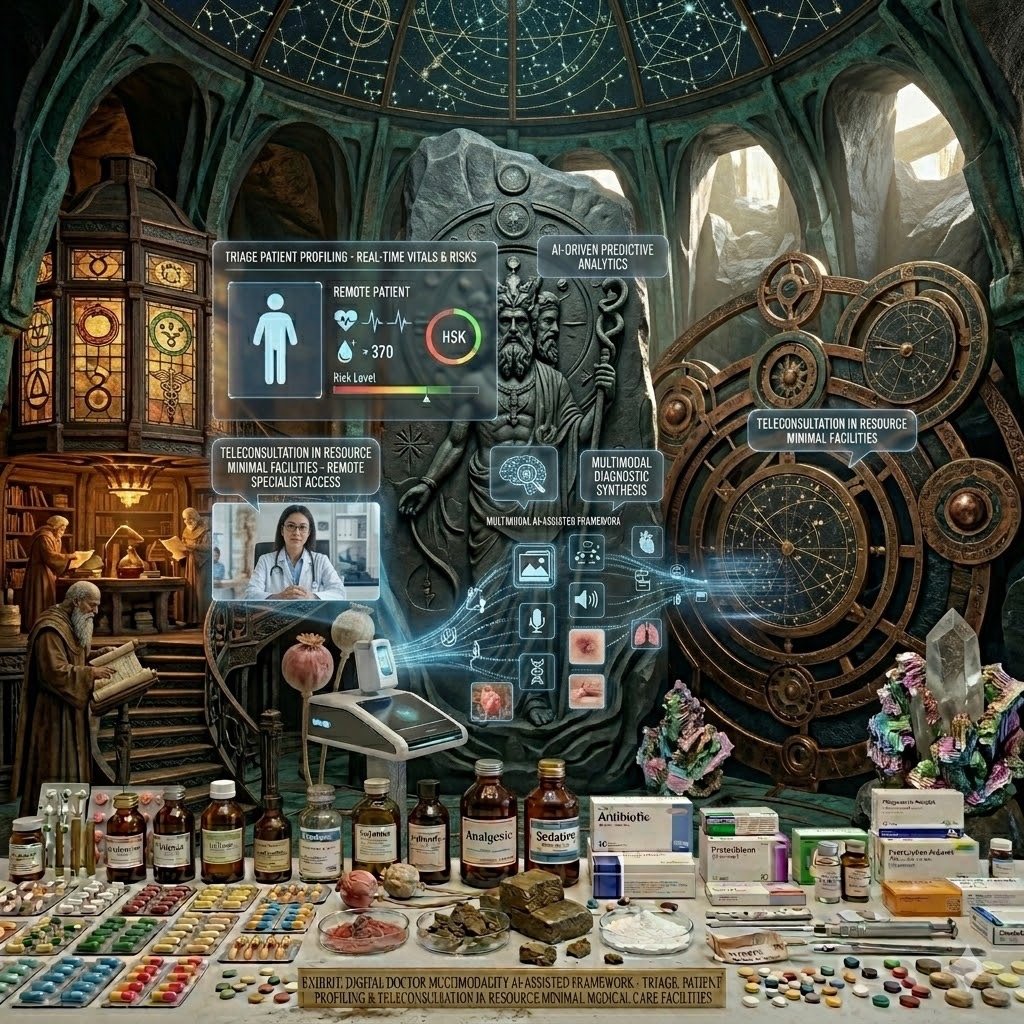
Digital Doctor Multimodality AI-Assisted Framework. Triage Patient Profiling and Teleconsultation in Resource Minimal Medical Care Facilities.
Nishant Rawat & Nidhi Shukla, Geeta University
Abstract: Limited resources in healthcare settings can result in disjointed patient data, clinician shortages, and inefficient first contact workflows. In this paper, it is proposed to introduce Digital Doctor, the framework that incorporates multimodal artificial intelligence that assists patients with onboarding, symptom tracking, vital-sign monitoring, report digitalisation, patient profiling, and human-supervision teleconsultation. The system design comprises of data acquisition and sensing layer, edge level verification that verifies that the data is correct, secure longitudinal data storage, and a review interface by clinicians.. This setup enables rapid patient-data collection, validity verification, and transmission of a summarised case form to healthcare providers. The framework follows a conservative design stance that includes multilingual support, offline operation, privacy-sensitive storage options, modular technology, and decision-making processes that preserve clinician control. A plan to evaluate measurement accuracy, referral sensitivity, processing latency, usability, and patient satisfaction is also proposed.
Index Terms
Artificial Intelligence, Digital health, Telemedicine, Health kiosk, Patient Profiling, Multimodal sensing, Triage, Teleconsultation.
I. INTRODUCTION
Many healthcare systems face challenges beyond clinician shortages; initial patient-contact workflows often remain fragmented, with incomplete measurements, paper-based reports that are difficult to preserve, and clinical histories that must be repeated during every visit. These issues increase delays, transcription errors, and the risk of missed escalation in critical cases. A structured point-of-care kiosk can reduce this friction by consolidating screening, record collection, and referral into a single access point.
Digital Doctor is designed to meet this need by consolidating core screening functions within one service module. Based on a patent concept developed by the inventors, the system aims to identify patients, capture anthropometric data, measure vital signs when feasible, scan supplementary reports, and transmit a generated clinical summary to a physician through a secure server. In this paper, the system is treated as a research-oriented framework suited to prototyping, validation, and controlled field deployment, with safety and clinical oversight built into the design.
This approach aligns with prevailing digital health guidance. The World Health Organisation (WHO) recommends evaluating digital interventions not only by technical innovation, but also by feasibility, acceptability, benefits, possible harms, resource use, and equity. For AI
enabled health applications, the WHO further emphasises ethics, transparency, accountability, and human-rights protection. Reporting standards such as CONSORT-AI, SPIRIT-AI, and TRIPOD+AI require explicit documentation of model inputs and outputs, failure scenarios, and human-AI interaction, all of which are especially relevant for patient
facing kiosks in primary care, outreach, and rural settings. Accordingly, this paper makes two main contributions. First, it translates the patent concept into a layered architectural model and a workflow aligned with clinical realities. Second, it situates the system within contemporary health-technology research by emphasizing traceability, reproducibility, usability, and governance. The aim is to show how a purpose-built
Digital Doctor platform can improve access and continuity without overclaiming the role of automation.
II. RELATED WORK AND DESIGN CONTEXT Research on health kiosks suggests that integrated kiosks are practical rather than speculative. In rural and low-resource settings, such systems have been shown to be useful and cost effective when implementation constraints are handled carefully. Scoping reviews also highlight the value of telehealth kiosks in settings where clinicians are not consistently present.
Telemedicine research supports this view by describing remote consultation, diagnosis, and monitoring as ways to reduce geographic, financial, sociocultural, and infrastructural barriers. At the same time, such studies acknowledge real operational issues, including variability in patient acceptance, scheduling inefficiency, and regulatory limitations. The key insight is not that telemedicine replaces face-to-face care, but that it extends care through a more structured workflow.
From a governance perspective, ethical and human-rights considerations must be built into AI-enabled health systems from the outset. WHO guidance calls for inclusive design, while CONSORT-AI and SPIRIT-AI require careful reporting of AI behavior, clinician interaction, and error management. TRIPOD+AI further promotes transparency in predictive modeling. These requirements are directly relevant to Digital Doctor, which is intended to function as a clinical decision support system rather than a general consumer health application.
Taken together, the literature supports a guiding principle: effective digital health systems facilitate rather than substitute clinical care by streamlining the first patient contact, preserving information flow, and helping patients reach a medical expert sooner.
III. PROBLEM STATEMENT AND DESIGN OBJECTIVES
Digital Doctor responds to the lack of a compact, economically viable, and clinically rigorous platform that can serve as the first step in patient screening and basic record management at the point of entry into a healthcare system. In
many communities, the initial encounter produces fragmented information and no reliable mechanism for long-term searchable continuity.
The patent describes a device capable of patient identification, acquisition of key physiological measurements, scanning of medical records, and secure transfer of final information to qualified specialists. Putting those capabilities into research language results in six design objectives, namely, accelerated patient onboarding, reliable vital-sign collection, documentation digitalisation, continuous patient profiling, intelligent triage, and patient-safe teleconsultation. A similarly significant seventh objective is that the system can be utilised in an environment where there are variations in power, variations in network access, and variations in operator skills. [1].
Due to the fact that the issue is a clinically sensitive subject and the system may influence medical decisions, the philosophy of the design has to be conservative. Digital Doctor is expected to be a facilitator of clinical data, identify missing or non-standard data points, and make referrals. It is not aimed at taking the place of clinicians. Rather, the system must be a sensible clinical guide that is effective, enlightening, and should never be beyond human control.[1]-[6].
IV. PROPOSED DIGITAL DOCTOR ARCHITECTURE Digital Doctor is an answer to the absence of a small, cost effective, and clinically rigorous platform that would incorporate patient onboarding, sensing, report digitisation, record storage, and teleconsultation into one workflow. The patent describes a device that is able to recognise the patient, capture significant physiological vital signs, scan medical documents and transfer the final information in a secure way. The way we understand this concept makes the operation that faces the patient straightforward and separate the sensing, validation, storage, and referral functions. Given the sensitivity of the issue, the system is created to mitigate and its potential effects on the clinical decisions, it should have a conservative design. The platform, therefore, uses safety checks and human review as central design features rather than optional extras.
A. Sensing and Interaction Layer
The primary task of the interaction layer is to support data input and primary sensing. It has mechanical components like a display, a microphone, a camera, and medical sensors where necessary.
The user interface is created in a specific manner to minimise the mental load on patients. Communications are executed using simple language and the system is designed to take the user through each process without having to engage the expert.
B. Nursing Intervention and Patient Management. The edge validation process has the responsibility of performing initial quality and plausibility checks on information prior to their passing to other downstream elements. Duplicates of incorrect readings, absent records and suspicious outliers are identified as duplicates or manually checked.
Patient profiling also occurs at this phase. Once the reliability of the identification of a particular patient has been achieved, the current data of a session could be combined with any available longitudinal profile to ensure continuity and provide enhanced interpretation.
C. Secure Record and Remote Consultation Layer. The record layer provides a safe storage of authenticated clinical records, consultation notes and coded patient records. It allows authorised users controlled access and maintains a record of the history of previous visits.
In case of network access, the platform assembles a teleconsultation-ready referral summary with the patient profile, critical measurements, symptoms, and the evidence that has been scanned.
D. Governance, Privacy and Security Layer.
The health-related data that the system must deal with is sensitive and hence the system must be default-secured. The security controls are authentication, encryption, logging, and access limitation.
Governance is not a characteristic but a prerequisite in accordance with the international ethics and reporting standards of digital health and AI-enabled medical systems.
We have four layers in architecture, each being interdependent and having its defined but complementary functions in the digital healthcare system. The lowest layer deals with the interaction and the first sense with the patient. The second layer does real-time data validation and lightweight reasoning of data on the edge, near the source of data. The third layer is patient-record storage, which is encrypted and allows the use of teleconsultation in case of available connectivity. The fourth layer finally summarises these inputs into a succinct, clinician analysis, ready-to-use summary that aids in final analysis and clinical judgement. Such a hierarchical overlay ensures that the cost of local devices remains inexpensive and that more complicated processing and long term data storage is handled by cloud infrastructure, balancing both cost and capability. [1].
In this type of design, the data acquisition and the clinical judgment are separated intentionally. This decoupling is necessary due to the fact that the reliability of the data gathering will be different based on the modality used, i.e. the use of cameras to verify an identity, use of speech recognition to interact with the customer, use of OCR to digitise reports, and use of rule based logic to refer. A camera is useful in recognising the patient, but it cannot be used as the sole method
of certain identity verification. Similarly, clinical value to blood-pressure measurements is validated, although it requires verification against known plausible ranges. OCR is able to extract the text of reports and the extracted text must be authenticated prior to being incorporated into permanent medical records, in order that mistakes may not be transmitted. [1].
V. RESULTS & DISCUSSION
Its workflow is designed as linear since all the phases are confirmed before advancement to the next level. After arriving at the kiosk, the patient must carry out identity verification using the assistance of a mobile phone number, profile identification, or any other locally applicable form of registration. The system accesses the available records or establishes a new profile in case one is not present. According to the patient consent, facial and other biometric identifiers can be taken to ensure continuity of the sessions [1].
The system will then ask the patient to explain in the predominant local language the chief complaint. To facilitate coding of the data collection process, the responses are coded in certain symptom scales rather than being represented as free text. Then, the kiosk can measure various vital parameters and indicators, including height, weight, blood pressure, oxygen
saturation, temperature as well as blood glucose level (depending on the sensors used). Automatic trigger of measurements that result into outlier or unrealistic values.
repeat readings. Supporting documents are scanned with OCR and shown to operators for confirmation before incorporation. [1].
When the data collection process is complete, the system integrates the patient profile, symptom description, sensor based measurements, and scanned reports into a single case record. One safety-verification layer is rule-based and evaluates the presence of critical clinical signs, including severe oxygen desaturation or hypertensive crises. If such thresholds are exceeded, the case is escalated to human intervention. For non-urgent presentations, the system produces a referral summary to support teleconsultation or other clinical action. [1].
A. Patient Onboarding and Identity Resolution
Onboarding of patients must be effective and precise. Facial recognition may be added to identity verification where deemed necessary, but should be one of many signals due to confounding variables, including the use of masks, low light, camera position, demographic diversity, and local policy limitations. Manual verification tools are also suggested to enhance safety by using a confidence-based identity resolution system [1].
The continuity of care is of the utmost priority, and this means that profiles of the patients have to be upheld across the encounters and this will also mean that the encounter can be experienced in another day or a different physical location. This continuity enhances the worth of kiosk systems by forming a heavy longitudinal history, as opposed to a session by-session aggregate of data items in isolation. [1].B. Symptom Acquisition and Report Digitisation
The symptom-query process is intentionally brief and direct, with the approach centred on clinical relevance rather
than lengthy free-form discussion. The symptom checklist usually includes the nature of pain, fever, cough, respiratory distress, fatigue, gastrointestinal issues, dizziness, wounds, and current medication use. Linguistic support is tailored to the local context so that it can support natural interaction and improve the completeness and correctness of symptom reporting. [1].
Paper-based report digitisation remains a critical issue because physical documentation still exists in many clinical environments. OCR is used to extract laboratory values, prescriptions, and referral notes so that they can be integrated into electronic records. Notably, OCR results should be treated as tentative data that must be manually verified, since handwritten legibility and scan quality can lead to accidental errors being stored. [1].
C. Multimodal Triage and Referral Logic
The triage process transforms gathered information into clinical suggestions. The triage algorithm integrates three important aspects: definitive safety thresholds, a broader risk stratification score, and exception handling to address incomplete or contradictory input data. The safety thresholds are to detect the emergent conditions when urgent actions are required, one can prioritise patients with the help of the risk scores, and the exception handling prevents unsupported confident recommendations when the input data are scarce. [1], [2]-[6].
This is an intermediate solution that would agree with the clinical urgency of implementation of kiosks and focus on foreseeable and cautious behaviour in the case of uncertainty. Even though machine learning models may assist in prioritising cases according to their probability, clear safety rules may override model results in cases where any important parameters show a potential emergency. This implies that Digital Doctor is simply a decision-support system to clinicians, but not a diagnostic system on its own. [1], [2]-[6].
Fig. 2. Digital Doctor workflow and triage flow chart.
The suggested framework stands out as especially different when compared to the traditional telemedicine platforms since it does not start with a video-first interaction but with a structured local intake process. Unlike standard health kiosks, which are largely focused on a single measurement, the proposed system will incorporate intake and longitudinal patient profiling and clinician assessment. This kind of a concerted approach is particularly relevant in resource-limited environments where the initial point of contact should be able to transform information into a clinically viable format and facilitate timely decision-making. [7]-[11]. Table II proposes a comparison of the existing digital-health solutions and the suggested one. The benefits of telemedicine visits are that the patients can have rapid access to the physicians remotely, though they need to use self-reported information, which can be incomplete or incorrect. The proposed system is more effective by relying on objective sensing technologies, creating well-developed patient profiles, and combining cases to provide a clinical evaluation that is more context-dependent. Conventional health kiosks focus on convenient local measurement but may not necessarily have a mechanism of collecting or storing longitudinal patient data. The gap is addressed by the proposed framework because it captures the patient history and referral continuity. Symptom checkers that are based on AI offer a wide range of triage assistance but are not as safe as medical grade. The solution suggested will overcome these shortcomings through the inclusion of human controls, preset safety limits, and authenticated data-collection mechanisms to enhance reliability and safety. [7]-[11].
D. Evaluation Framework
Before deployment, measurement accuracy, referral sensitivity, latency, usability, patient satisfaction, and OCR
extraction accuracy should be tested and compared with reference tools and clinician judgment [7]-[11].
E. Implementation Considerations.
To be deployed in an environment where electricity is not always reliable, network connections are inconsistent, and operator skills vary, the kiosk design must be usable and durable. User interfaces should have large, well-labeled controls, intuitive iconography, and step-through processes that minimize the chance of omitting critical steps. Offline capability is essential; encrypted data must be stored on-site during connectivity loss and synchronized later without affecting information integrity. [1].
The choice of hardware needs to be highly practical and long-lasting rather than aesthetically enhanced. Important elements include a stable imaging system, well-calibrated medical or consumer-level sensors, and a secure embedded processor.
tamper-resistant components and an enclosure designed to withstand harsh environmental conditions. The aim is to build a sustainable platform that can be scaled to support different environments, such as clinics, outreach programs, schools, and
neighborhood health centers, instead of a demonstration device. [1].
It is also necessary to make the software modular. The core functionalities should consist of loosely coupled, interchangeable components such as identity management, sensor data collection, OCR processing, triage algorithms, summarization, and teleconsultation modules. Such architectural adaptability minimizes systemic risk and enables testing, replacement, and improvement of individual subsystems without disrupting platform stability. [1].
F. Ethical, Clinical, and Regulatory Considerations The ethical framework supporting Digital Doctor should be clearly defined. The user interface must communicate clearly that the system is intended as clinical support and not a replacement for the judgment of a trained physician. This transparency is important because the system may appear highly confident even though the underlying models have limitations. Automation can be dangerous in healthcare,
particularly when the interface looks refined and authoritative. [2], [6].
Particular consideration should be given to equity. Inconsistent facial-recognition results under different lighting, age, or skin-tone conditions can lead to unintentional exclusion of some groups. Similarly, language processing across dialects may be inaccurate, and a symptom may be misinterpreted without immediate detection. Thus, thorough demographic and linguistic analysis, together with fallback mechanisms, is needed to ensure stable functionality when automated processes are ambiguous. [2], [6].
Effective data governance should be part of the process. This includes clearly defined intended use cases, validation protocols, update mechanisms, consent models, comprehensive logging strategies, and adverse-event management processes. Although deployments that are not strictly defined as medical equipment are not governed as such, compliance with standards characteristic of clinical software development can make them safer and more trustworthy. [2], [6].
G. Discussion
The Digital Doctor system does not rely on one algorithmic innovation, but combines routine procedures into one, patient centred care pathway. Patients require more than a classified output per se, they require an interactive way of communication, the ability to store medical history, easy measurement tools and human clinicians whenever they are needed to justify it. Such a system can act as an important initiative to lessen friction at both ends of the continuum of care [1]-[11].
This integrative value is particularly needed in cases where the travel time, bureaucracy and redundant histories of patients make early contact with healthcare impossible. The first lines of structured contact by means of decentralization in the form of kiosks make it possible to stimulate earlier care escalation and enhance continuity. Moreover, keeping records of the patient profiles helps in supporting revisitability and prevents recreation of clinical histories each time the patient is met. [1]-[11].
Nevertheless, the system design must be wary regarding capability. There is no sensor-based kiosk that can suggest any of the clinical information, and no speech-recognition interface can be regarded as a safe substitution to clinical reasoning. Digital Doctor is best applicable when it aids in making sure that the right information is delivered to the appropriate healthcare professional and at the right time, with sufficient contextual information to it. Such a contribution is eminent in resource constrained environment. [1]-[11].
VI. CONCLUSION / FUTURE WORK
The present paper is a research proposal based on the concept of a Digital Doctor, which was inspired by the patent application submitted by the inventors and assessed by a literature review on the topics of telemedicine, health kiosks,
and artificial intelligence regulation [2]-[11]. It defines a platform established as a construction of interconnected processes, such as patient authentication, the acquisition of vital signs, digitization of reports, symptom collection, primary clinical examination, and teleconsultation organization. This is facilitated by the fact that it is modular and is especially useful in resource-constrained environments. [1]-[11].
The most significant advantage of the suggested system is that it is pragmatic. It is not based on the unrealistic infrastructure, it does not imply that patients have to go through a disintegrated care path, and it is not aimed at substituting healthcare workers. Rather, it sets a predetermined access point and facilitates continuity of care, fewer delays in service-delivery, and easier referrals. Digital Doctor can enhance the interaction between patients and medical workers provided it is controlled with the required due diligence on the areas of validation, privacy and human control. In addition to the academic value, the suggested workflow can be used in practice in a real-life healthcare environment as it can lead to the improvement of the efficiency of patients admission, the reliability of triage, and service continuity in the spheres of clinicians and facilities where one can apply the suggested workflow. Future research opportunities include AI-based decision-making, sensing with the Internet of things to link and connect, and clinically and secure cloud synchronisation to make the platform more scalable, adaptable, and clinical effective. [1]-[11].
ACKNOWLEDGMENT
The inventors are acknowledged by the authors who gave the idea of the patent that was the first stimulus on this work. The reviewed literature will also include guidelines and peer reviewed studies that the World Health Organization has published concerning digital health, telemedicine, health kiosks and regulating artificial intelligence in healthcare. [1].
REFERENCES
[1] N. Rawat et al., "Digital Doctor," Indian Patent Application No. 202311065877, Sep. 30, 2023. [2] World Health Organisation, Ethics and Governance of Artificial Intelligence in Health. Geneva, Switzerland: WHO, 2021.
[3] Recommendations on Digital Interventions to Strengthen Health Systems. Geneva, Switzerland: WHO, 2019. [4] X. Liu, S. Cruz Rivera, D. Moher, M. J. Calvert, and A. K. Denniston, "Reporting guidelines of clinical trial reports of interventions involving artificial intelligence: The CONSORT-AI extension," Nat. Med., vol. 26, pp. 1364- 1374, 2020.
[5] S. Cruz Rivera, X. Liu, A. K. Chan, A. K. Denniston, and M. J. Calvert, Guidelines on clinical trial protocols of
interventions with artificial intelligence: The SPIRIT-AI extension, Natal. Med., vol. 26, pp. 1351-1363, 2020. [6] G. S. Collins, K. G. M. Moons, P. Dhiman, and R. D. Riley, "TRIPOD+AI statement: updated advice on reporting clinical prediction models that utilise regression or machine learning techniques," BMJ, vol. 385, p. q902, 2024.
[7] M. Letafat-Nejad, P. Ebrahimi, M. Maleki and A. Aryankhesal, "Integrated health kiosks utilization: a systematic review," Med. J. Islam. Repub. Iran, vol. 34, p. 114, 2020.
[8] P. A. Anawade, D. Sharma and S. Gahane: A comprehensive review of the study of effects of telemedicine on healthcare accessibility, Cureus, vol. 16, no. 3, e55996, 2024.
[9] M. E. V. Chagas et al., Are we appropriately assessing patient satisfaction of telemedicine? A meta-analysis systematic review, Telemed. J. E Health, vol. 30, no. 6, pp. 1522-1538, 2024.
[10] T. Razi et al., "Patient satisfaction of telehealth services during primary care," Telemed. J. E Health, vol. 30, no. 11, pp. 2704-2711, 2024.
[11] W. Cheng et al., "A protocol of a cluster randomised clinical trial: evaluating a village-based digital health kiosks program," Digital Health, vol. 8, p.
20552076221129100, 2022.
Resources
“Powering growth through expert-crafted knowledge—because the right resource at the right time can change everything.”
Support
Connect
support@thelegalsoul.com
thelegalsoul@gmail.com
+91 9289171838 (Whatsapp)
© 2025. All rights reserved.