GENDER PERFORMATIVITY AND LAW: RETHINKING LEGAL IDENTITY BEYOND THE BINARY FRAMEWORK
Indian law has long anchored itself in a strict male-female binary when it comes to gender identity, shaping everything from rights and duties to protections in courts and statutes. Yet, drawing from feminist and queer theory—especially Judith Butler’s idea of gender performativity—this paper argues that gender is not a biological given but something enacted through repeated social practices, norms, and expressions. It is fluid, contextual, and deeply personal. This article examines how Indian jurisprudence has begun to open up to gender diversity, particularly through landmark Supreme Court decisions, while highlighting the stubborn binary assumptions that persist in the Bharatiya Nyaya Sanhita, 2023 (BNS), Bharatiya Sakshya Adhiniyam, 2023 (BSA), and Bharatiya Nagarik Suraksha Sanhita, 2023 (BNSS). Using a doctrinal and critical lens, it contends that these frameworks fall short of delivering substantive equality for transgender and non-binary individuals. True alignment with constitutional ideals of dignity, equality, and autonomy requires embracing self-identification and gender-neutral drafting. A performative understanding of gender, I suggest, can push law toward greater inclusivity and justice.
RESEARCH PAPER
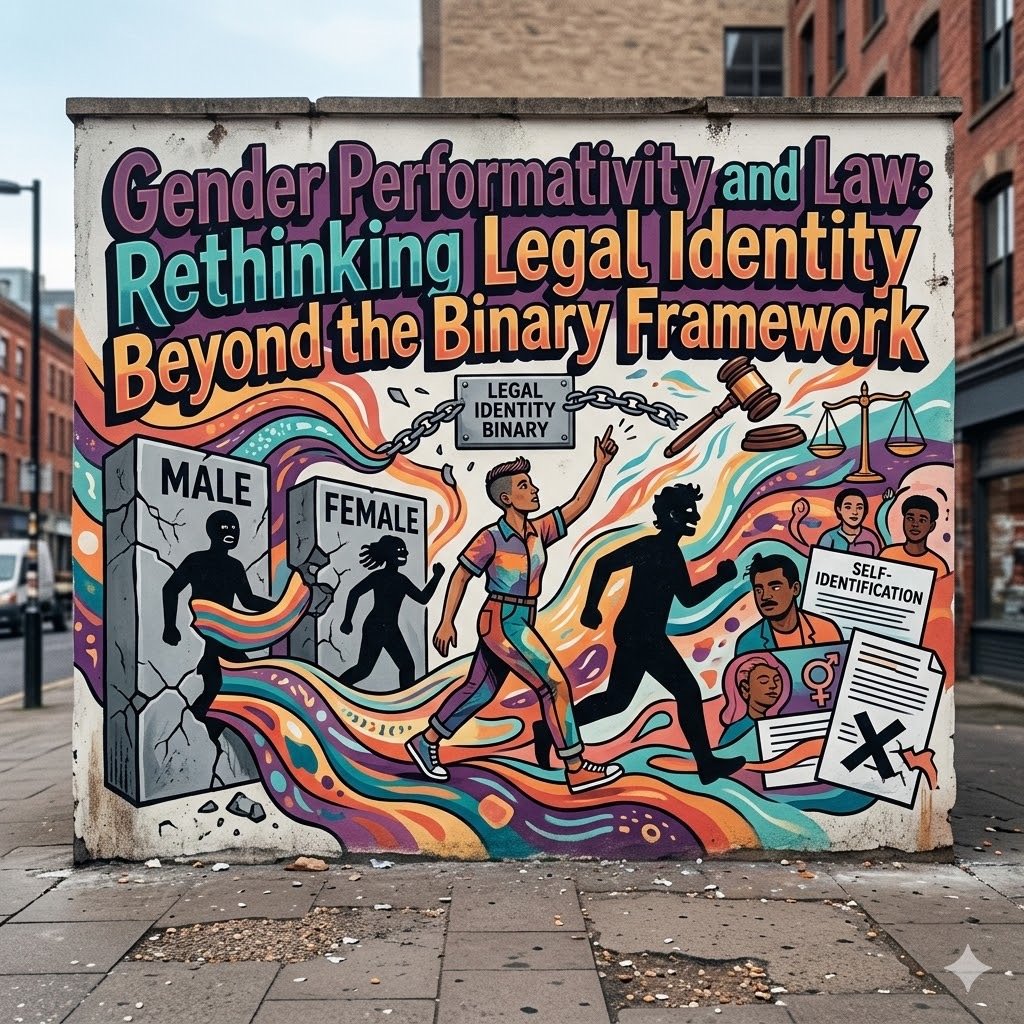
Gender Performativity and Law: Rethinking Legal Identity Beyond the Binary Framework
Shatakshee Rawat, Shibli National College
Keywords: Gender Performativity, Queer Jurisprudence, Transgender Rights, Binary Legal Frameworks, Indian Constitutional Law
1. Introduction
Law does more than regulate behaviour; it actively shapes how we understand ourselves and others. In India, as elsewhere, legal systems have traditionally treated gender as a fixed, binary category—male or female—rooted in biology and presented as natural and unchanging. This approach has influenced everything from inheritance and marriage to criminal liability and evidentiary rules, often rendering non-conforming identities invisible or marginal.
Feminist and queer scholarship has long contested this essentialism. Central to this critique is the notion of gender performativity: the idea that gender emerges not from some inner essence but through the repeated performance of acts, gestures, and behaviours that society recognises and reinforces. Far from being stable, gender is contingent, produced in social interactions, and open to subversion. This perspective invites us to question why law clings to rigid classifications and to imagine legal identities that better reflect the lived, fluid realities of individuals.¹
2. Theoretical Framework: Gender as Performance
At the heart of gender performativity lies the argument that what we call “gender” is constituted through iterative acts—ways of dressing, speaking, moving, and relating—that create the appearance of an underlying, coherent identity. These performances are not freely chosen in a vacuum; they are regulated by powerful social norms that reward conformity and punish deviation. Yet, because they must be constantly repeated, they also carry the potential for disruption and change.
Applying this to law reveals a fundamental mismatch. Legal regimes that insist on gender as an objective, biological fact overlook how identity is enacted and experienced.² They risk reducing complex human realities to checkboxes, thereby denying dignity to those whose performances fall outside the binary. A performative lens urges law to shift from fixed categories toward recognition based on self-identification, allowing individuals to author their own gendered selves within the social and legal sphere.³
3. Constitutional Vision and Judicial Developments
The Indian Constitution, through Articles 14, 15, and 21, enshrines commitments to equality, non-discrimination, and the right to life and personal liberty with dignity. Over the years, the judiciary has interpreted these provisions expansively to embrace gender diversity.
The turning point came in National Legal Services Authority v. Union of India⁴, where the Supreme Court recognised transgender persons as a “third gender” and affirmed their fundamental right to self-identify their gender. The Court stressed that denying such recognition infringes upon dignity and autonomy, interpreting “sex” under Article 15⁵ to include gender identity alongside biological attributes.
This foundation was reinforced in Justice K.S. Puttaswamy v. Union of India⁶, which elevated privacy—including decisional autonomy over one’s body and identity—to a fundamental right under Article 21⁷. In Navtej Singh Johar v. Union of India⁸, the decriminalisation of consensual same-sex relations further underscored that constitutional morality must yield to individual dignity and equality, rejecting majoritarian prejudices against LGBTQ+ persons.
Cases like Shafin Jahan v. Asokan K.M.⁹ similarly affirmed the right to choose one’s partner and, by extension, aspects of personal identity as integral to liberty. These rulings signal a judicial willingness to move beyond biology toward a more expansive understanding of selfhood.
4. Statutory Framework and Its Limitations
Despite judicial advances, the statutory landscape—particularly the new criminal laws effective from 2024—continues to embed binary assumptions, creating gaps between constitutional promise and everyday application.
4.1 Bharatiya Nyaya Sanhita, 2023 (BNS)
While the BNS includes “transgender” within the definition of “gender” (referring back to the 2019 Transgender Persons Act), its substantive provisions on sexual offences remain largely gender-specific. Rape and related offences (around Sections 63–76) are framed with male perpetrators and female victims in mind. The deletion of the old Section 377 IPC¹⁰, without a robust replacement, has left transgender and male victims of sexual violence with limited recourse—often reduced to general hurt provisions or the lighter penalties under Section 18¹¹ of the Transgender Persons Act. This structure not only excludes non-binary and transgender experiences but also perpetuates impunity for certain forms of violence, failing to reflect the performative, diverse realities of gender-based harm.
4.2 Bharatiya Sakshya Adhiniyam, 2023 (BSA)
The BSA modernises evidence rules with greater recognition of electronic records, but it offers little explicit guidance on accommodating gender-diverse witnesses or testimony. Questions of credibility, demeanour, and relevance in trials involving transgender or non-binary individuals risk being filtered through unexamined binary lenses, potentially undermining fair adjudication and reinforcing stereotypes.
4.3 Bharatiya Nagarik Suraksha Sanhita, 2023 (BNSS)
Procedural safeguards for arrest, search, and custody retain gendered binaries. Provisions for searches of arrested persons or exemptions (e.g., for women in certain contexts) do not consistently address the dignity and safety concerns of transgender individuals. Without clear, inclusive protocols, law enforcement practices can lead to humiliation, misgendering, or violence, directly clashing with Article 21 protections.
These limitations illustrate how statutory inertia lags behind judicial evolution, constraining the transformative potential of performativity-informed rights.
5. Expanding Judicial Interpretation
Progressive lower court rulings offer glimpses of what inclusive interpretation can achieve. In Arun Kumar v. Inspector General of Registration¹², the Madras High Court read “bride” inclusively to encompass a transgender woman, extending personal law protections. Post-NALSA jurisprudence has repeatedly emphasised self-identification, yet the lack of comprehensive statutory codification leads to uneven implementation across states and institutions.
Ongoing challenges, including recent legislative debates around self-identification requirements, underscore the fragility of these gains and the need for courts to continue vigilantly safeguarding constitutional baselines.
6. Need for Transformative Legal Reform
To truly integrate a performative understanding of gender, law must evolve in several directions:
Gender-neutral drafting: Replace binary-specific language (“man,” “woman,” “bride/groom”) with inclusive terms like “person” or “spouse,” while remaining attentive to contextual vulnerabilities.
Statutory recognition of self-identification: Embed the principle from NALSA into primary legislation, minimising gatekeeping that undermines autonomy.
Procedural reforms in BNSS and BSA: Introduce explicit guidelines for respectful treatment in custody, searches, and testimony, including training on gender diversity and sensitivity to performed identities.
Institutional and educational measures: Mandate sensitisation programmes for police, judiciary, and legal professionals to dismantle binary biases and foster empathy for fluid gender expressions.
Such changes would not merely tinker with existing rules but reorient law toward recognising identity as an ongoing, self-authored performance—better serving constitutional values in a diverse society.¹³
7. Conclusion
The tension between evolving constitutional jurisprudence and persistent binary structures in statutes reveals law’s dual role: both a site of exclusion and a potential vehicle for emancipation. Gender performativity offers a compelling critique, exposing how rigid classifications obscure the enacted, relational nature of identity. While Indian courts have carved out important space for diversity, legislative reform is crucial to translate these ideals into consistent, lived protections.
A legal order that embraces gender as fluid and self-determined would more faithfully uphold dignity, equality, and personal liberty. Moving forward, scholars, activists, and lawmakers must collaborate to bridge the gap—ensuring that law does not lag behind the rich multiplicity of human experience but actively supports it.
References
Judith Butler, Gender Trouble: Feminism and the Subversion of Identity (Routledge, 1990).
Boston Women’s Health Book Collective, Our Bodies, Ourselves (Simon & Schuster, New York, 2008).
V.K. Ahuja and Arya A. Kumar, Gender Justice: Contemporary Developments (Law & Justice Publishing Co., New Delhi, 2025.)
National Legal Services Authority v. Union of India, (2014) 5 SCC 438.
Prohibition of discrimination on grounds of religion, race, caste, sex or place of birth.-
(1)The State shall not discriminate against any citizen on grounds only of religion, race, caste, sex, place of birth or any of them.
(2)No citizen shall, on grounds only of religion, race, caste, sex, place of birth or any of them, be subject to any disability, liability, restriction or condition with regard to-
(a)access to shops, public restaurants, hotels and places of public entertainment; or
(b)the use of wells, tanks, bathing ghats, roads and places of public resort maintained wholly or partly out of State funds or dedicated to the use of the general public.
(3)Nothing in this article shall prevent the State from making any special provision for women and children.
(4)Nothing in this article or in clause (2) of article 29 shall prevent the State from making any special provision for the advancement of any socially and educationally backward classes of citizens or for the Scheduled Castes and the Scheduled Tribes.
(5)Nothing in this article or in sub-clause (g) of clause (1) of article 19 shall prevent the State from making any special provision, by law, for the advancement of any socially and educationally backward classes of citizens or for the Scheduled Castes or the Scheduled Tribes in so far as such special provisions relate to their admission to educational institutions including private educational institutions, whether aided or unaided by the State, other than the minority educational institutions referred to in clause (1) of article 30.
Nothing in this article or sub-clause (g) of clause (1) of article 19 or clause (2) of article 29 shall prevent the State from making,—
(a) any special provision for the advancement of any economically weaker sections of citizens other than the classes mentioned in clauses (4) and (5); and
(b) any special provision for the advancement of any economically weaker sections of citizens other than the classes mentioned in clauses (4) and (5) in so far as such special provisions relate to their admission to educational institutions including private educational institutions, whether aided or unaided by the State, other than the minority educational institutions referred to in clause (1) of article 30, which in the case of reservation would be in addition to the existing reservations and subject to a maximum of ten per cent. of the total seats in each category.
Explanation. -For the purposes of this article and article 16, “economically weaker sections” shall be such as may be notified by the State from time to time on the basis of family income and other indicators of economic disadvantage.
Justice K.S. Puttaswamy v. Union of India, (2017) 10 SCC 1.
Protection of life and personal liberty. No person shall be deprived of his life or personal liberty except according to procedure established by law
Navtej Singh Johar v. Union of India, (2018) 10 SCC 1.
Shafin Jahan v. Asokan K.M., (2018) 16 SCC 368.
Section 377 of IPC: Unnatural offences: whoever voluntarily has carnal intercourse against the order of nature with any man woman or animal shall be punished with imprisonment for life or with imprisonment of either description for a term which may extend to ten years and shall also be liable to fine
Explanation.- penetration is sufficient to constitute the carnal intercourse necessary to the offence described in this section.
Offences and penalties.
Whoever,—
(a) compels or entices a transgender person into forced or bonded labour (excluding government-imposed public service);
(b) denies or obstructs a transgender person's access to public places;
(c) forces a transgender person to leave their home or place of residence;
(d) harms, injures, or endangers the physical or mental well-being of a transgender person, including through abuse, shall be punishable with imprisonment for a term which shall not be less than six months but which may extend to two years and with fine
Arun Kumar v. Inspector General of Registration, 2019 SCC 8773.
Christine Hudson, Malin Ronnblom, et al.,Gender, Governance and Feminist Analysis: Missing in Action? (Routledge, New York, 2017).
Resources
“Powering growth through expert-crafted knowledge—because the right resource at the right time can change everything.”
Support
Connect
support@thelegalsoul.com
thelegalsoul@gmail.com
+91 9289171838 (Whatsapp)
© 2025. All rights reserved.